Accounting
Year-End Physical Inventory Count Checklist for Manufacturers and Distributors
By AJ Singh · Published November 10, 2026
Manufacturing & Distribution · Year-End Close
Your year-end count drives your cost of goods sold, your profit, and your tax bill. Here is what to do before, during, and after the count, and where the tax rules are stricter than your inventory software.
Book a Free ConsultationCall (909) 217-7855
AJ Singh, CPA, EAStandalone inventory reconciliationClients in all 50 states
How Your Inventory Count Feeds Cost of Goods Sold
Cost of goods sold is what the products you sold cost you. Your tax return figures it the same way every year:
| Step | What it means |
|---|---|
| Beginning inventory | Last year's ending count |
| + Purchases, labor, and other production costs | What you bought and spent to make product this year |
| − Ending inventory | This year's count, priced under your inventory method |
| = Cost of goods sold | Subtracted from sales to get gross profit |
Illustrative example: overcount ending inventory by $50,000, and cost of goods sold drops by $50,000, so taxable profit rises by $50,000 this year. Next year the error flips, because that $50,000 is now beginning inventory.
Corporations and partnerships report this on Form 1125-A, which also asks whether you wrote down goods you couldn't sell at normal prices or changed how you figured quantities or values. Sole proprietors use Part III of Schedule C.
Physical Inventory Count vs. Cycle Counting
A physical inventory count checks everything at once. Cycle counting means counting a small slice of your stock on a set schedule, such as a few bins each week, so every item gets counted during the year. It needs a perpetual inventory system, meaning software that updates quantities with every receipt, sale, and production step.
The tax rules allow this: the regulations say book inventories should be "verified by physical inventories at reasonable intervals." The tax code also accepts a year-end shrinkage estimate (for lost, stolen, or damaged stock) if you count each location on a regular schedule and correct the estimate to actual counts.
Year-End Physical Inventory Count Checklist · gns-cpas.com
The Year-End Physical Inventory Count Checklist
Before the count (2 to 4 weeks out)
- Set the date. Plan to stop receiving, shipping, and production during the count.
- Write count instructions, including each item's unit of measure (each, box, pound).
- Clean and label every location. Move damaged or obsolete items to one marked area.
- Get pre-numbered count tags and log every number issued.
- List goods on your floor that others own, and goods you own that sit elsewhere.
- Decide how you will count and value work in process.
- Post every receipt, shipment, and production entry.
- Form count teams of two, including someone who doesn't keep inventory records.
During the count
- Freeze movement. Log anything that must move.
- Use blind counts, meaning counters don't see the quantity in the system.
- Tag each location once, and have a second person check each tag.
- Flag damaged, obsolete, and slow-moving items on the tag.
- Record work in process by job, with how far along it is.
- Note the last receiving and shipping document numbers.
- Have a supervisor recount a sample of high-dollar items.
- Collect every tag, including unused and voided ones.
After the count
- Account for every tag number, and recount large differences before adjusting.
- Test cutoff using the last document numbers.
- Add goods you own that are off-site or in transit. Remove goods you don't own.
- Price the count under your inventory method, same as last year.
- Reconcile to your general ledger, investigate variances (differences between the count and the books), and document the adjustment.
- Review obsolete and slow-moving stock for books and taxes separately.
- Keep tags, count sheets, and variance notes with your year-end records.
Cutoff: Getting Receiving and Shipping Right
Cutoff decides which year each receipt and shipment belongs to. Goods that arrived before the count get counted, with the purchase recorded this year. Goods that shipped before the count stay off the count, with the sale recorded this year. Both rules hold unless ownership, called title, passed at a different time (see consigned and in-transit goods below). Test a few documents on each side of the last receiving and shipping numbers from count day.
Counting Work in Process Inventory
Work in process is product that is partly built. For each open job, record the item, the quantity, and how far along it is. Value it with the costs in it so far: materials, labor, and a share of factory overhead, such as factory rent and utilities. Under the standard tax rules, manufacturers must include overhead; the small-business method below can change that. The tax regulations specifically reject valuing work in process "at a nominal price or at less than its proper value," so don't leave it off or plug in a round number.
Consigned and In-Transit Goods: Count What You Own
For taxes, inventory follows ownership (called title), not location:
- Goods you placed with another business to sell for you (consigned out) are still yours. Count them.
- Goods someone else consigned to you are not yours. Leave them out.
- Goods in transit to you count once title passes to you, even before they arrive.
- Goods you sold belong to the buyer once title passes, even if they're still on your dock.
Your purchase orders, invoices, and shipping terms usually show when title passes. Material at an outside finishing shop still counts if you own it.
Count Sheets and Tags
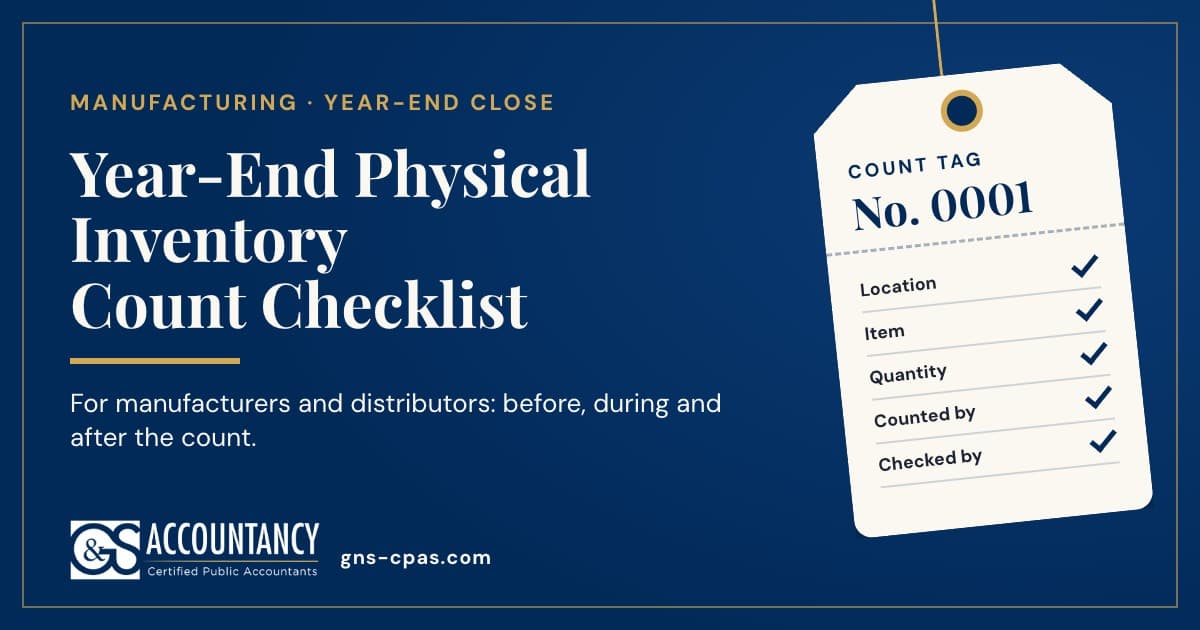
Pre-numbered tags help show nothing was counted twice or skipped. Each tag shows the tag number, location, item number, description, quantity, unit of measure, condition, and who counted and checked it. Having someone other than the recordkeeper check the counts is a basic internal control. The tax regulations say inventory records should be legible and kept with your accounting records, so file the tags.
Reconciling the Count to Your General Ledger
Reconciling means proving that your priced count equals the inventory balance in your general ledger, or explaining every dollar that doesn't. It works like a bank reconciliation, but for items on shelves. Common causes of differences:
- Unit-of-measure mix-ups (a box counted as one piece)
- Receipts or shipments posted in the wrong period
- Unrecorded scrap or samples
- Items stored in two places
- Wrong item costs
- Real loss or theft, called shrinkage
Recount first, then book one documented adjustment and fix the cause. A count that matches the books also makes your monthly management reports worth trusting.
G&S offers standalone inventory reconciliation. We can help plan the count, reconcile it, investigate variances, and document the adjustment, whether or not we keep your books.
Obsolete and Slow-Moving Stock: Book Rules vs. Tax Rules
For your books: under the accounting standards (ASC 330), inventory measured with FIFO (first in, first out) or average cost is carried at the lower of cost and net realizable value (expected selling price minus reasonable costs to finish, sell, and ship). LIFO (last in, first out) inventory still uses lower of cost or market.
For taxes, the standard inventory rules are stricter:
- Inventory is valued at cost, or the lower of cost or market, where "market" generally means today's replacement cost. LIFO inventory stays at cost.
- A general reserve for obsolete stock is not allowed.
- Damaged or out-of-style goods can be valued at a lower selling price only if you actually offer them at that price within 30 days after the inventory date, and keep records. Damaged materials and partly built goods are never valued below scrap value.
- Too much of an item is not enough. In Thor Power Tool Co. v. Commissioner (1979), the Supreme Court denied a write-down of excess parts the company kept selling at full price. The write-offs the IRS allowed there were for goods scrapped or sold at reduced prices.
So flag slow-moving items during the count, then decide what to scrap, mark down, or keep, and document it.
The Small-Business Inventory Method (Section 471(c))
For tax years beginning in 2026, a business averaging $32 million or less in annual gross receipts (total sales and other income before expenses) over the three prior tax years can generally skip the standard inventory rules. It can treat inventory as non-incidental materials and supplies, a tax option that deducts the cost in the year the goods go to the customer (or the year you pay for them, if later). Or it can follow the inventory method in its books and records. If it has audited financial statements, or financial statements it files with a government agency, it follows the method in those instead. CPA-reviewed or compiled statements used only for a lender or owners don't count.
That doesn't mean your count stops mattering. Examples in the regulations say that if your books use your year-end count, for example to value inventory in reports to your lender or your owners, your tax return must use that count too. The same gross receipts test also exempts a business from the section 263A uniform capitalization rules, which make larger businesses add certain overhead to inventory.
Cautions: related businesses under common control may have to combine gross receipts, some businesses are excluded, and switching methods generally means filing Form 3115, the IRS application to change an accounting method.
How G&S Helps Manufacturers and Distributors at Year-End
We help with the accounting side of the count for manufacturers, distributors, and other inventory-heavy businesses: planning, reconciling, investigating variances, and carrying the right numbers into cost of goods sold. You make the final decisions on your books. If a lender asks for compiled or reviewed financial statements (statements that come with a CPA's report under professional standards), inventory is often one of the largest numbers on the balance sheet. Whether we can also review your statements depends on our independence under CPA ethics rules, which limit some other work for the same client. See how we work with manufacturers. Based in Rancho Cucamonga, California, we serve clients in all 50 states.
Frequently Asked Questions
How often should you do a physical inventory count?
Plan on a full count at least once a year, at or near year-end, since your tax return needs an ending inventory number. If your software updates quantities with every receipt and sale (a perpetual system) and you count every item on a schedule during the year (cycle counting), those counts can stand in for one full count.
Do I have to count inventory on the last day of the year?
Not necessarily, but closer is better. If you count on another date, adjust for everything received, shipped, and used between the count and year-end, and keep that work with your records.
Can I write off obsolete inventory for taxes?
Only in limited cases. A general reserve for obsolete stock is not allowed. Damaged or out-of-style goods can be valued lower if you actually offer them at that price within 30 days after the inventory date. Scrapped goods come off inventory, but excess stock you keep selling at full price generally can't be written down.
Do small businesses have to keep inventory for taxes?
For tax years beginning in 2026, businesses averaging $32 million or less in annual gross receipts (total sales and other income before expenses) over the three prior tax years can generally use a simpler method under section 471(c). If your books use a year-end count, including in reports to your lender or owners, the tax method generally follows it.
Get Your Count and Your Books to Agree
Planning a year-end count, or stuck with a count that won't match your general ledger? Talk to us before you close the year.
This content is general information, not tax, accounting, or legal advice for your situation, and reading it does not create a client relationship with G&S Accountancy Inc. Talk to a qualified professional about your facts. Tax thresholds are current for tax years beginning in 2026 and change every year. Whether we can issue a review of your financial statements depends on our independence, and some bookkeeping and consulting services can't be combined with a review for the same client. AJ Singh, CPA, EA, enrolled to practice before the IRS.
AJ Singh leads G&S Accountancy's tax strategy and audit-defense practice with more than 15 years of experience representing taxpayers.
Ready to Simplify Your Finances?
Schedule a free consultation and find out how G&S can help your business grow.